
Who hasn’t read an Agatha Christie mystery or watched a TV or film adaptation? Miss Marple and Poirot are instantly recognizable figures and The Mousetrap is the longest running play in London’s West End. If you watch the BBC game show The Traitors you will recognise the closed circle of suspects ploy from her books, her influence is everywhere in literature and film. The Agatha Chrsitie – World of Mystery exhibition celebrates Christie’s life from childhood to her death in 1976. Tickets are from £20 and it is showing until June 2027. There are also free things to see at the British Library, located in London’s King’s Cross, including the Treasures Gallery which displays, amongst many other things, a scrap of the Magna Carta and writings from the third century. You can also see a pair of tiny tortoiseshell spectacles thought to have belonged to Jane Austen.
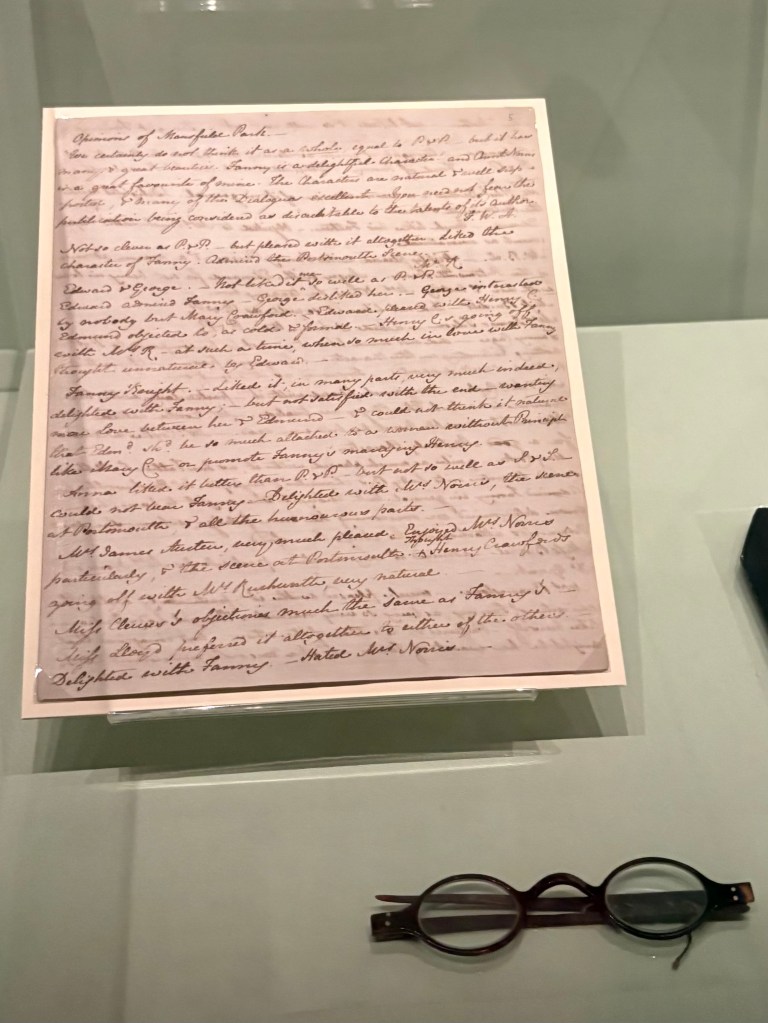
Tiny spectacles thought to have belonged to Jane Austen
There is a mystery to solve if you wish to participate with clues placed in every room of the exhibition. This adds a little fun to the proceedings and visitors are issued with a pencil and card for notetaking. The first room is a mock up of a drawing room with family photos on display. Christie, born Agatha Miller in 1890, was educated at home and was twelve years younger than her beloved sister, Madge. There is some very touching correspondence between the sisters on display. She seemed to have had a happy childhood although her father mismanaged the family finances and died in 1901 leaving his wife and daughters in some financial difficulty.
Christie used a formula of seven questions to craft her novels Who? Why? When? How? Where? Which? Her notebooks are on display throughout the exhibition and this made me think that so few people write things down anymore. The writers of today probably have their notes and drafts saved somewhere in the cloud, it seems such a pity as there is something very personal about seeing a person’s handwriting. Her first published mystery was The Mysterious Affair at Styles, published in 1920, which introduced her famous Belgium detective, Hercule Poirot. Christie named her own country house in Sunningdale, Styles. Poirot has been played by many distinguished actors over many years , David Suchet, Peter Ustinov Albert Finney, Austin Trevor , Tony Randall, Alfred Molina, John Malkovich and most recently, Kenneth-Branagh.
Many of us I think would associate the elderly unofficial but very effective detective, Miss Marple with British actress Joan Hickson . Christie was a member of The Detection Club who’s oath was to never conceal from a reader a vital clue which may help them solve the mystery.
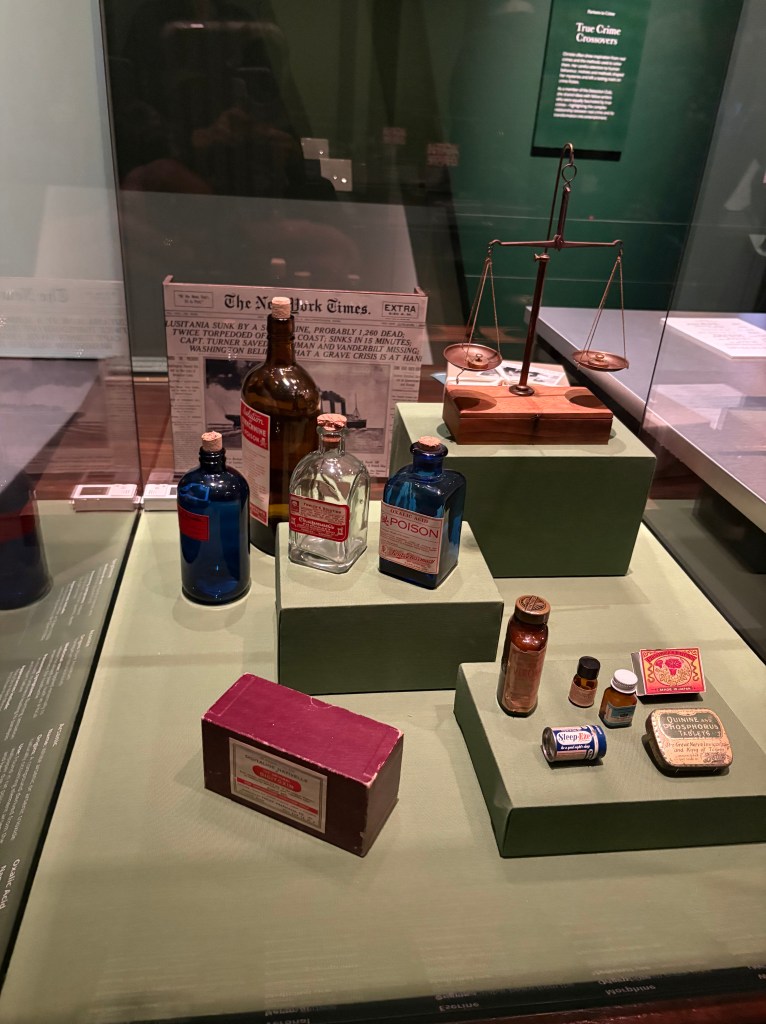
Poison was a popular method of murder in Christie’s books
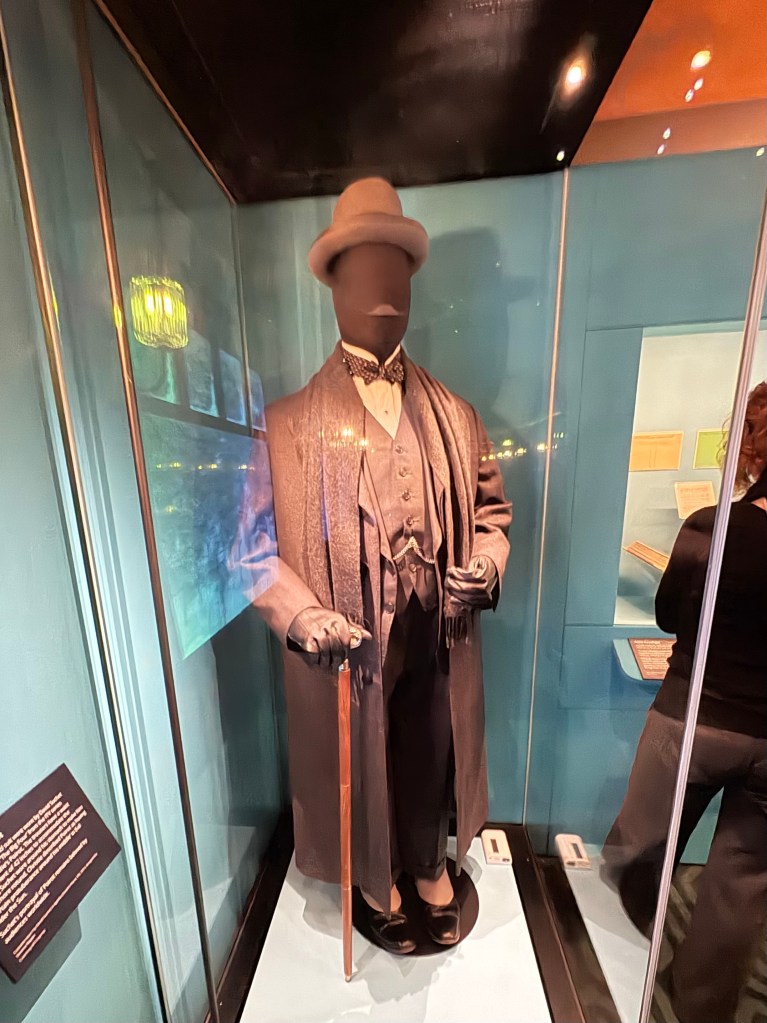
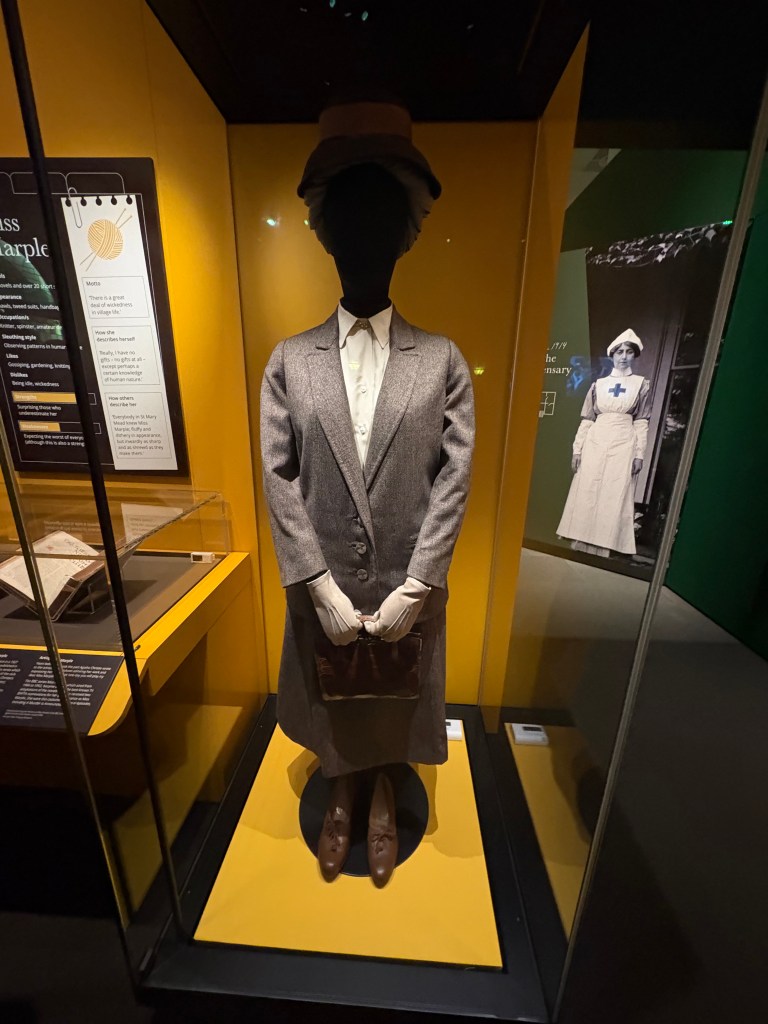
Hercule Poirot and Miss Marple costumes
Christie created a mystery in her own personal life when in December 1926, upon hearing that her husband Archibald wanted a divorce after he had fallen in love with another woman, she went missing for eleven days. Her car was found at the edge of a quarry. She had checked into a hotel in Harrogate under the name of her husband’s mistress, Teresa Neele. Lord Conan Doyle even joined in the search as did Dorothy L. Sayers. Conan Doyle even consulted a medium about her disappearance. The medium, Horace Leaf, was accurate in his prediction that she would be found after a few days of searching. Christie blamed her disappearance on amnesia and the whole episode was rather brushed under the carpet. Christie had one daughter, Rosalind with Archibald .
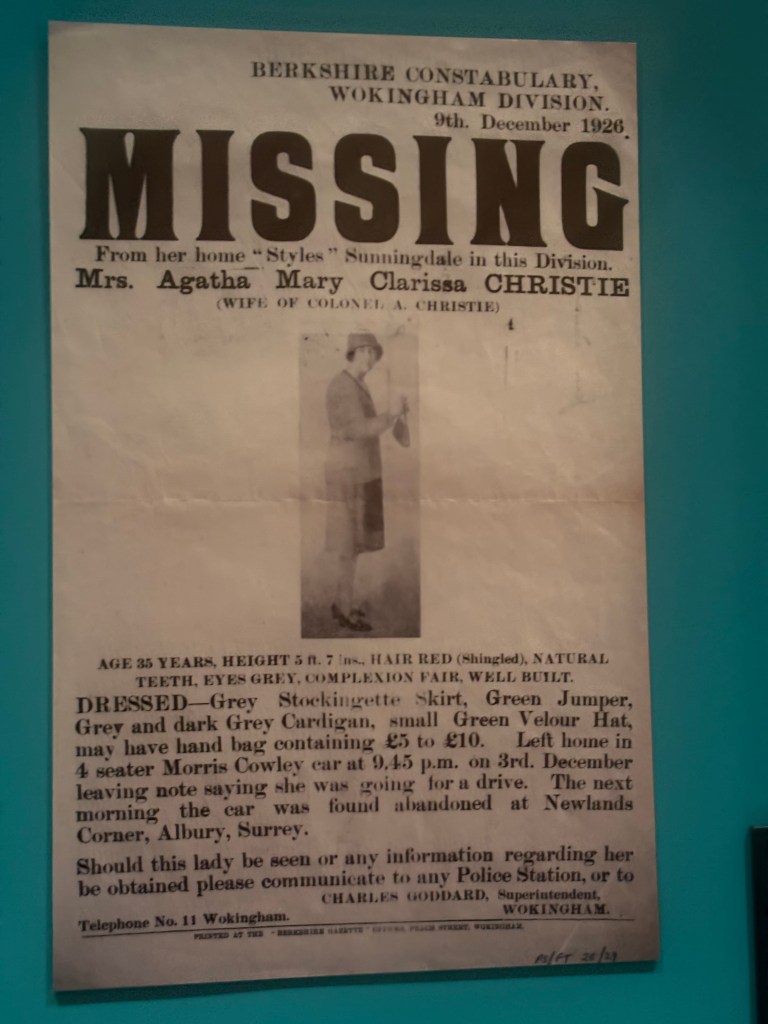
In 1928 Agatha and Archibald divorced and in 1930 she met archaeologist Max Mallowan. Christie accompanied Max on many digs in Syria and Iraq and a section of the exhibition is devoted to this time. Various artefacts are on display. It appears to have been a very happy time in the author’s life.
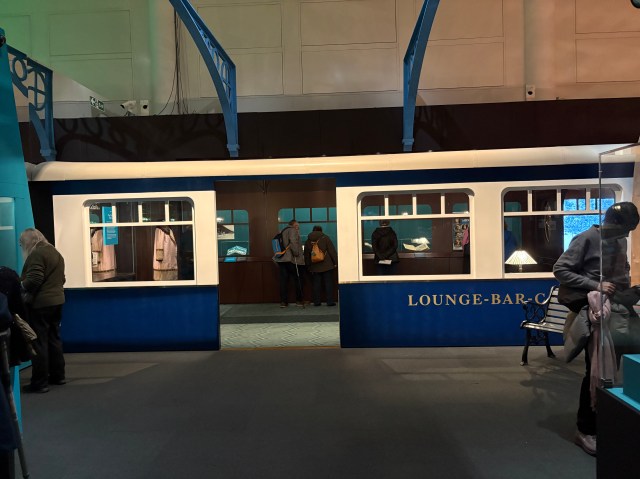
An exhibit based on Christie’s Poirot detective story Mystery of the Blue Train, published in 1928. This is a very realistic train carriage. There are moving scenes of wintery landscapes in the windows which did make me feel a little dizzy. The exhibition is supported by Great Western Railway.
One reason I wanted to see this particular exhibition is that I have recently been reading Christie’s books published under her pen name of Mary Wesmacott. These stories aren’t mysteries but rather tales of family life and relationships seen from a woman’s point of view. it seems that Christie was an extremely insightful person and I have really enjoyed these books which include Absent in the Spring and A Daughter’s a Daughter. I do plan to read the entire series.
At the end of the exhibition there is a film playing of Christie accepting an award in 1962 rom Richard Attenborough . It was to celebrate ten years of the Mousetrap being performed on the stage. She gave the most charming speech . She was awarded numerous accolades during her lifetime, much deserved as she was a record breaking playwright as well as an author of ninety five bestselling books. At one time she had three plays showing in the West End of London, The Mousetrap, Witness for the Prosecution and Spiders Wed, a huge accomplishment.
This is such an interesting exhibition about an exceptionally talented woman. If you decide to go you may want to read one or two of her books beforehand. There is, of course, a beautiful but rather expensive gift shop where you can purchase some additions to your own library.
Thank you for reading
Samantha

